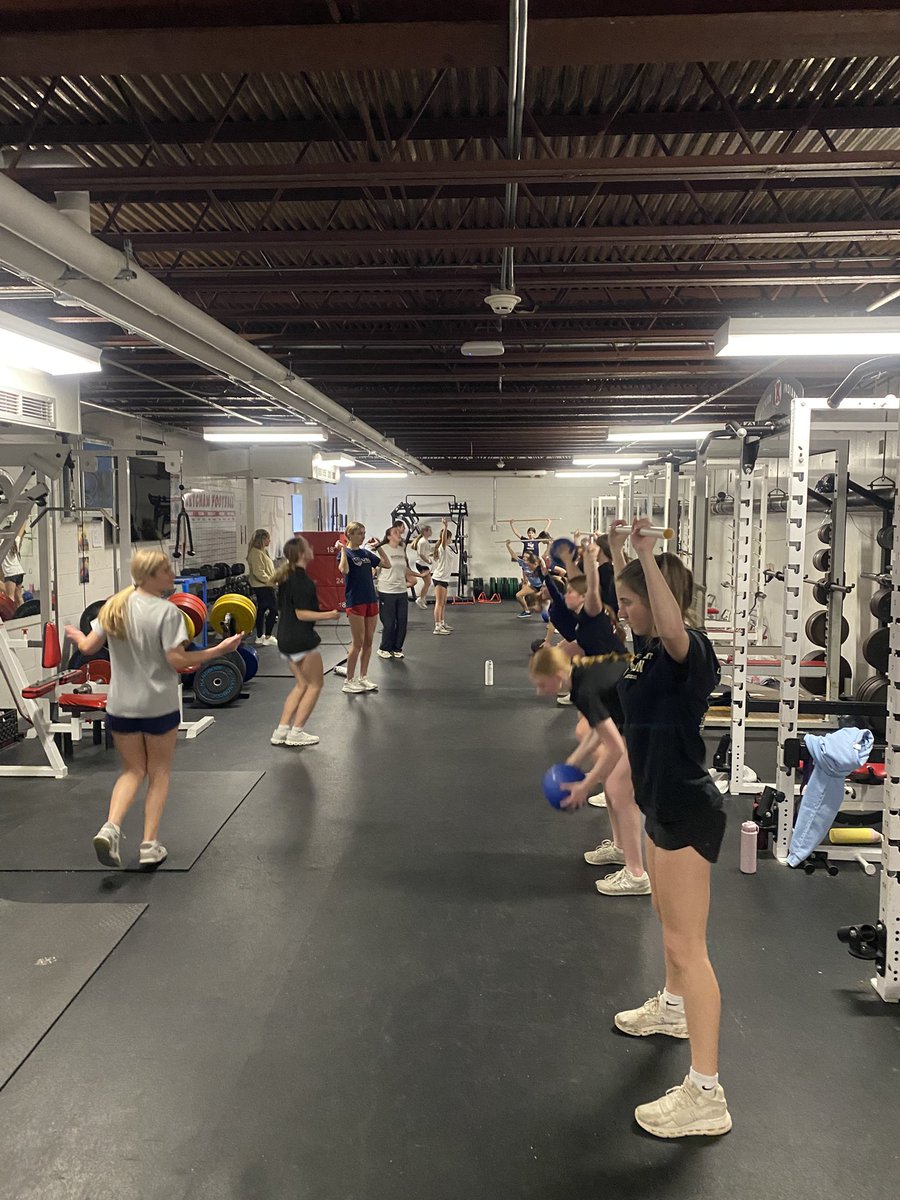
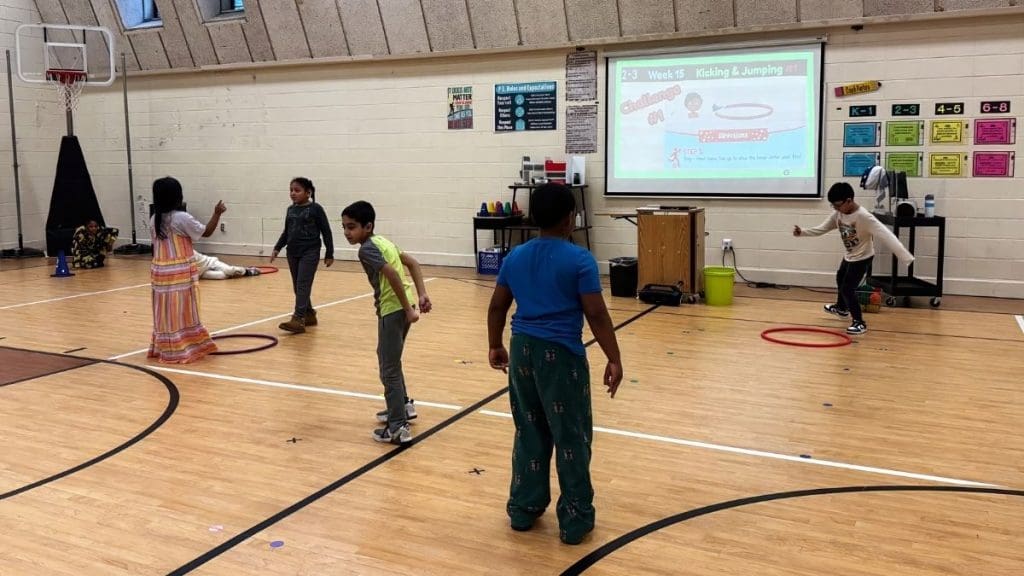
At Johnson Street Global Studies K–8 Magnet in High Point, North Carolina, physical education is built around one goal: helping students grow year after year. The Title I school serves nearly 400 students across grades K–8.
The school follows an extended-year calendar with roughly 195 instructional days. For veteran PE teacher Michelle Pastore, that schedule creates a rare opportunity. “I have those kids from K through 8,” she explains, “and because we’re extended year, I’ve had them for a full extra calendar year by the time they reach 8th grade.”
That continuity allows her to reflect not only on student growth, but also on her instruction. “It allows me to reflect on my own teaching—what they’re getting and what they’re missing, and what they carry from K–5 to middle school.”
Michelle is also the only PE teacher in the building, responsible for all nine grade levels. That means teaching K–8 requires range—different activities, cues, pacing, and developmental needs—all in the same day.
With so much variety and limited time between classes, Michelle has tapped into PLT4M as a game-changer. “To pull resources from one platform and use them interchangeably is such a tremendous help,” she explains. “It’s a one-stop shop.”
For her K–8 setting, PLT4M provides the curriculum, technology, and teaching tools that support continuity across every grade span—and helps her manage the reality of teaching nine grades under one roof.
The Challenge of Teaching K-8 Classes In One Day
Michelle’s schedule reflects the reality of K–8 PE: rapid transitions and constant shifts across developmental levels. “On any given day,” she explains, “it might be seventh grade, eighth grade, kindergarten, then third grade, second grade, fifth grade, and sixth.”
Teaching nine grade levels isn’t just about knowing different skills. It’s also about managing the daily logistics that come with it. Each class requires different equipment, setup, cues, and pacing. There’s little time between groups to reset the gym or completely shift instructional style.
Michelle has to make sure every class walks in with a plan that meets them where they are—without losing consistency across the program.
And that’s the next challenge. With students moving through her program year after year, Michelle wants instruction to build over time—not feel like disconnected units. “The way PLT4M is designed—intermixing elementary and secondary—helps maintain continuity,” she explains. “It’s not teaching an overhand throw one way in K or 1 and then completely different in sixth or seventh grade.”
Instead of recreating lessons from scratch, Michelle can quickly pull the progression, visuals, and activities she needs for the specific class in front of her. “I just go to the program,” she says, “and grab the activity or visual representation of what I’m trying to teach.”
That combination—day-to-day flexibility and long-term structure—helps Michelle manage constant transitions while still building a cohesive K–8 program.
Why Visual Cues Matter More Than Ever
After 25 years in education, Michelle has seen a major shift with students: attention spans. “When I first started teaching,” she explains, “it was like a TV show—ten minutes, do something, take a break… but students can’t focus like that anymore.”
Her instruction has adapted. “Instructional delivery has to be instant,” she says. “Here’s what we want it to look like now, let’s try.”
That’s why visuals have become central to her teaching—especially in a K–8 environment. “In elementary and secondary, the videos and visual cues from PLT4M are broken down incredibly well,” Michelle explains.
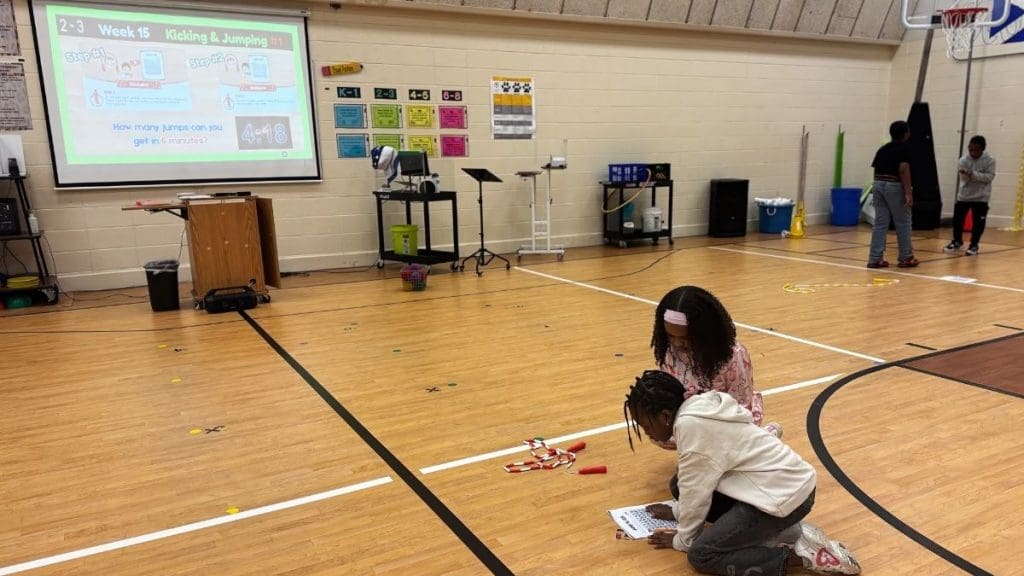
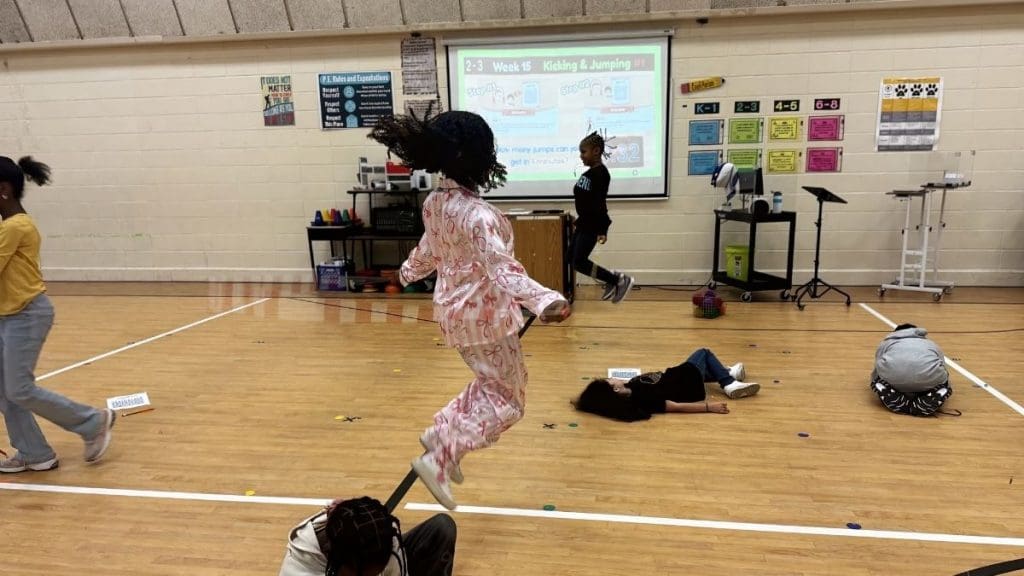
She uses a projector and large screen to display slides, skill videos, and visual prompts throughout class so students can see examples in real time. “Students know they can look at the visual cues at any point,” she explains. “Once I show them the intro video of whatever skill, I clip it and repeat it in a loop or GIF so they can see it constantly.”
That reinforcement matters. “The reinforcement piece is necessary,” Michelle says. Students revisit key cues without slowing the lesson down, and Michelle can differentiate more easily while keeping everyone moving. “It allows me to differentiate at the drop of a hat,” she says, “and it helps me reach more students—keeping them engaged and progressing.”
What a K–5 Looks Like
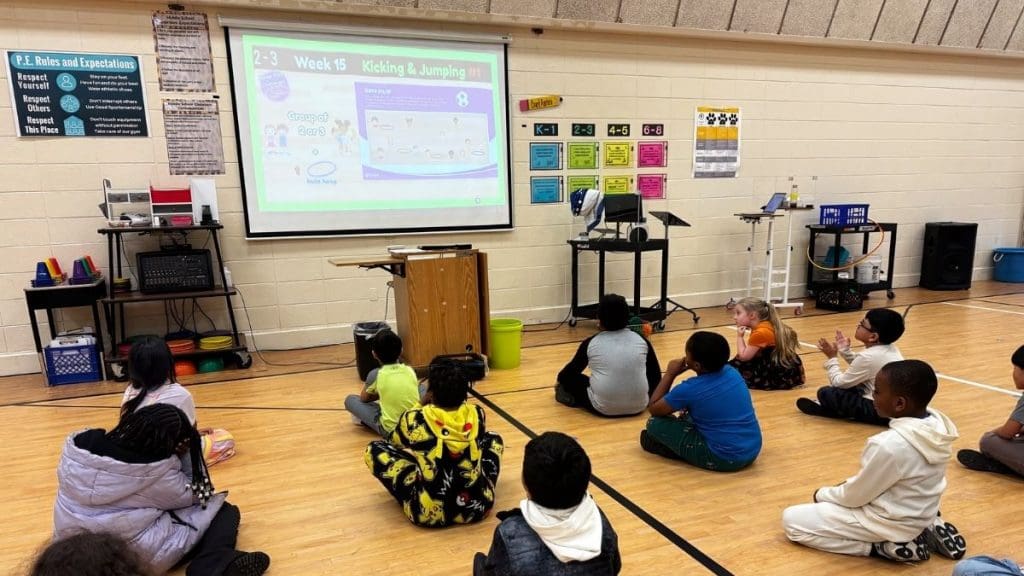
In K–5 PE, Michelle focuses on engagement, confidence, and age-appropriate skill development. She values resources that keep younger students focused while teaching clear movement cues and progressions.
“I followed Mike Graham (K–5 teacher) for years and was happy to see his work grow with PLT4M,” Michelle shares. “I love the visual cues—the graphics and characters on the screen. It draws and keeps their attention.”
She also appreciates that the visuals support more than skill instruction. They help students understand spacing and what activities should look like—especially with large groups moving at once.
Another major benefit is flexibility. “I can interchange the lessons as needed for different grade spans,” she says. “Sometimes I even use lessons suggested for younger students with older students to build confidence and success—because that grows.”
Michelle has also seen certain units create real breakthroughs. When teaching chasing, fleeing, and dodging, she followed the skill progressions closely and saw immediate results. “Because the kids have a hard time spatially, I followed it directly,” she explains, “and it was successful… I hadn’t had that type of success in like ten years with chasing and fleeing activities.”
For K–5, the goal is clear: lessons students can access, understand, and succeed in—while steadily building toward long-term mastery.
What 6–8 Day Looks: PE + Health on a Semester Schedule
Middle school PE at Johnson Street looks different. Students take PE daily for one semester, then rotate out for the other half of the year. For Michelle, that schedule changes her entire approach. She has similar topics to cover, but less time to do it.
“I’ve always had middle schoolers all year long,” she explains, “so now I have to approach my plan a bit differently to cover everything I want.”
In addition to PE, Michelle teaches health for grades 6–8. She often pulls PLT4M content to reinforce instruction, particularly in areas like nutrition and stress management. “I always harp on nutrition,” she says, noting how valuable it is to have multiple materials and approaches that reinforce the same message.
Michelle also points to the importance of SEL support in middle school. “Our middle school is very small,” she explains. “One little problem that happens at eight in the morning finds its way through the building all day.” Units connected to stress and self-management help students build the language and skills to navigate emotions more effectively.
Skill instruction remains important too. Whether teaching basketball, volleyball, pickleball, yard games, or badminton, Michelle relies on visuals to reinforce technique. “In badminton, the videos show it in slow motion and from different angles,” she explains, “and that makes it easier for kids to see than trying to demo in real time where they might miss it.”
Middle school becomes both skill development and health learning—and PLT4M helps Michelle move smoothly between both.
Sample video of dribbling skills for middle school students that Michelle uses in classes.
One Platform That Connects K–8
Across K–8, the most powerful theme in Michelle’s program is connection. Even though classes look different across grade levels, students learn consistent cues, experience steady progressions, and build a shared understanding of movement over time.
For Michelle, that continuity matters because it supports confidence and skill development year after year. “Getting kids to see and feel mastery of various skills so they can be successful—that’s the goal,” she explains.
She also appreciates the depth of the platform across both PE and health. “It really hits all the points a quality, well-rounded physical education program needs,” she says. “And it supports health too.”
As a teacher responsible for nine grade levels, Michelle values being able to pull what she needs quickly—and adapt it instantly. “I take pieces and fit them,” she explains. “It’s broken down in a way that just makes sense.”
For Johnson Street, PE isn’t disconnected from year to year. Students are building skills across grade spans. They’re learning through strong visual reinforcement. And they’re experiencing continuity from elementary to middle school—something made even more meaningful in an extended-year setting.
For Michelle Pastore, PLT4M isn’t just another resource. It’s a system that helps her teach better, reach more students, and build a consistent K–8 PE and health experience over time.


 ;
;